RSS
RSS

 Apr 30, 2012
Photos are a funny thing: they can often communicate things about us that are hard to convey in words, but many of us, when we’re being photographed, stop acting like ourselves: we try to force smiles, feel uncomfortable in front of the camera, or pose in a position we’d never take in real life.
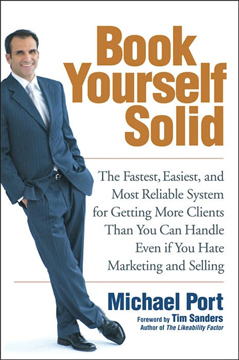
I’m no expert on how to get the perfect author photo, but I do know how to avoid some major mistakes because of my interest in and study of body language and facial expressions. As I mentioned in a recent post about Michael Port’s Book Yourself Solid, photos on business books are often the worst offenders, but I see many of these problems in author and promotional photos of all kinds. Here are some things to avoid.
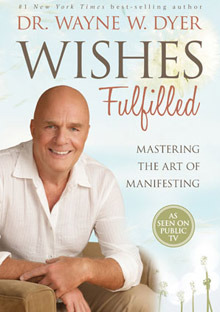
- A fake smile. A true smile can really light up a photograph, but considering we’re relating with cameras and photographers and not with friends or family when we get our picture taken, they can be hard to come by. People often can identify fake smiles without even trying, making the subject of the photo look sad and desperate. Even if you know what the difference between a real smile and a fake smile is, it’s next to impossible to smile convincingly without having something to smile about. Consider going without a smile, having the photographer tell you dumb jokes, or talking about something you’re passionate about-although this last strategy can result in a lot of photos of you with your mouth open. If that happens, stop talking and take time to reflect and create non-talking smiling opportunities every few sentences.
- Crossed arms. Unfortunately, a lot of businesspeople seem to think crossed arms indicate power and confidence. What they usually indicate instead is anxiety. We tend to cross our arms over our chest or stomach as a protective measure, an instinctive attempt to keep our vital organs from being damaged. Even touching our hands together or holding something that connects our hands is just a diluted version of crossed arms. Alternatives include having hands at our sides or behind our backs.
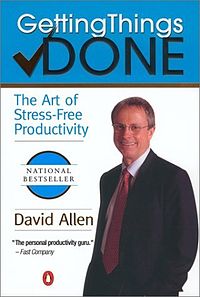 Hands in pockets. I think this is usually meant to suggest “Hey, I’m laid back and relaxed,” but in body language terms it often means “Please go away: I don’t want to talk to you.” This is not an ideal message for your photo. Interestingly, having hands in your pockets with thumbs sticking out, while still not especially inviting and open, tends to convey confidence, so if you absolutely have to hide your fingers, at least show your thumbs.
- Crossed ankles. This seems to be another favorite “relaxed” pose, but in body language it commonly translates as “I’m holding something back” or “I have something to hide.” I can’t blame people for wanting to cross their arms over their chests or cross their ankles when in front of the camera, because lenses really can make us feel vulnerable unless we’re very used to being photographed or can consciously befriend the camera. Still, uncross those ankles! In addition to looking less sketchy, this helps us actually feel more open, because our body language doesn’t just transmit our emotions: it also helps shape them (see “Using Body Language to Change Our Moods“).
- Touching the face. I think the intention is to imply “thoughtful,” but when we touch our faces in real life, it often more specifically signals doubt, or at least deliberation. For instance, you may be touching your face as you read this if you’re still trying to decide what to do with what I’m saying. If the chin is resting on the hand, the message can be boredom. In author photos, there’s a tendency for face touching to appear to be self-doubt, which again is probably not what you want to advertise.
 While there are other mistakes we can make, these five are the big ones, and avoiding them helps convey a sense of openness and reliability. Actually, though, the best way to use these pointers might not be to try to avoid the five mistakes, but to use them as a red flag and realize when we’re not comfortable in front of the camera. The most effective photos won’t be ones where we’ve just managed to avoid body language errors, but ones where we’re actually feeling open, energetic, and engaged. With that said, the worst promotional and author photos, at least in terms of the poses the subjects take, will be the ones where these errors slip by and go unnoticed-so at the least, let me implore you not to fall for any of them.
In case you’re interested in learning more, much of the material for this post comes from things I learned from Barbara and Allen Pease’s exceptional resource The Definitive Book of Body Language.

 1 Comment
  author photos, body languages, photos, promotional photos

 Michael Port’s bestselling marketing book for service professionals,
 Recently Janine and I attended a series of six weekly classes (with substantial homework assignments) taught by parenting advisor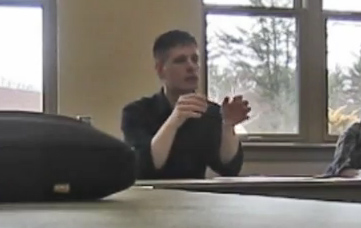
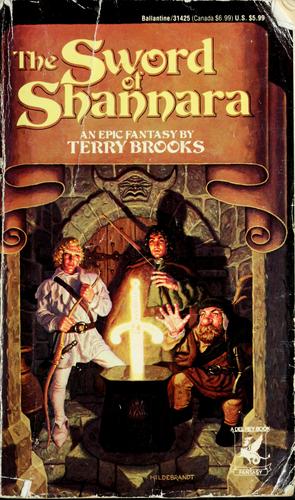 I suppose it was 20 years ago or more that I read Brooks’ Sword of Shannara. I found it to be an unrepentant rip-off of Lord of the Rings. I had no writing aspirations at the time, but after reading that disaster, I thought “Well, anyone can write a book.” And then it was a short step to “I can write a book.”
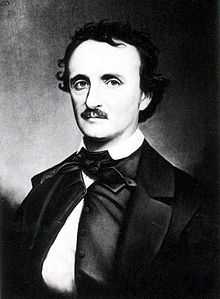 Poe. I started reading him when I was seven, while those moronic learn-to-read first-grade textbooks were being stuffed down my throat. Death from boredom…. I never wanted to learn to read–I wanted to be outside doing things. My dad tried to teach me starting at age four, and I despised it. Then elementary school almost murdered me with dreariness. Squash, crush, stifle. Man, did Poe revive me. The way he used language! By the time I was ten, I’d read all the fiction and poetry he ever wrote. I used to think the word, “poetry,” came from his name. He taught me to use words to give the world hard edges. He started me writing stories because stories gave my strapped-down childhood a shape I could control. I was a child, I wasn’t allowed to do real things, I wasn’t free, so I wrote. I still write to give the world hard edges, to be free. Poe was the first writer to save my life. I honor him.
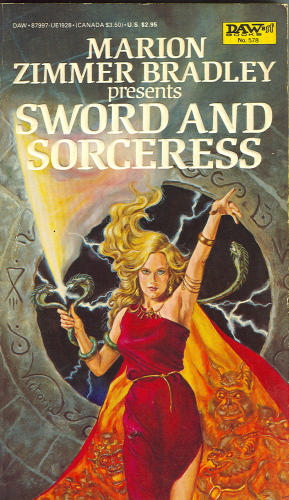 I first tried writing for publication after reading Marion Zimmer Bradley’s Sword & Sorceress series. I commented to my husband that it would be such fun to write for something like that, and he encouraged me to give it a try. S&S was invitation-only by then, and shortly thereafter MZB died and the series ended. By then, though, I’d had a story accepted by The First Line, and I was hooked.