Subscribe via RSS or e-mail      


Inclusivity and Exclusivity in Fiction: Pamela Rentz on People Running Off to Have a Vision Quest

Society and culture

This is the ninth interview and the eleventh post in my series on inclusivity and exclusivity in fiction. You can find a full list of other posts so far at the end of this piece.

In today’s interview we talk with author Pamela Rentz, a member of the Karuk Tribe.

Red TapeLUC: As both a member of a California tribe and a SF writer who writes Indian characters, what needs do you see in SF-or in literature in general-for growth or change? What’s broken right now in regard to Indian characters in fiction?

PAM: When Indian characters show up in stories, too often it’s to act out a narrowly defined role that’s about being Indian. They have to have names with hawk or eagle or bear in them. Some sort of personal spiritual quest is involved. In spec fiction they have to be shapeshifters. To be fair, I remember reading a great story, I think in F&SF, that featured a terrific Indian character and I’ve just spent about fifteen minutes trying to track down the author and title with no luck. But I still see a lot of the magical indigenous person, the spiritual wise one, the romanticized historical Indian. Or, who would have predicted this would develop in my lifetime: the casino Indian. Even in journalism I see the same tired narrative: a non-Indian person has managed to secure the trust of a group of Indians and via this special access is able to share his non-Indian perspective of what “real” Indians are like. The resulting story generally shows terrible poverty and/or something spiritual and exotic.

Where are the Indian detectives and librarians and space mission leaders and zombie hunters?

I’ve been asking myself what needs to happen to bring out more variety and depth to Indian characters and I’ve love to see more Indian writers telling their stories. I’m not suggesting that non-Indians can’t write Indian characters and especially the speculative fiction community tends to be better informed and more likely to do their homework. But, unless you’ve spent some time around Indian people it’s going to be difficult to capture the depth of characterization and unique Indian perspective I feel is missing.

I’m definitely seeing more Indian kids in social media and showing off great talent merging the traditional with the contemporary in fashion, music and art. I’m not aware of much fiction but I’m hoping it’s happening out there somewhere.

LUC: Why do you think that so many writers fall into the trap of Indians as keepers of some kind of secret knowledge or experience that reflects “real” Indians when, ironically, by doing that they’re ignoring the experiences of real real Indians?

PAM: That’s a terrific question. I wonder that myself.

I think part of it is that, not just writers, but most people don’t spend a lot of time with Indian people. I’m trying to figure out the best way to clarify this. Indian identity can be a touchy subject and I’m not trying to pick any fights here. What I’m talking about is spending time with Indians in connection with their Indian communities. Its one thing to have a friend or colleague who’s Indian and another thing to spend time in Indian Country.

Indian communities tend to be isolated and often not especially welcoming to outsiders. It’s tough to get an idea of the culture without seeing the tribal connections. I don’t feel like I really got it until I began working in Indian Country and seeing people from different tribes interacting and similarities in behavior. Things that I saw in my family but never connected to a bigger picture. As a writer, how can you give the Indian an authentic role without observing it yourself?

But then, why not see Indians like everyone else? There are Indian lawyers and school teachers and insurance adjusters. I don’t watch Law & Order but I understand that when Adam Beach (Saulteaux First Nations) was brought on the show his character was a detective who happened to be Indian not they needed an Indian character so they hired him. I saw Wes Studi (Cherokee) in a role once that wasn’t specifically Indian. In movies it seems like Indians show up because they need an Indian, but rarely because the appropriate actor happened to be an Indian. Of course, if you have a character and you cast them as Indian for no reason other than to be diverse, I guess that fails, too.

I think writers fall into traps with Indians for the same reason we often fall into traps when we’re inventing any kind of character. It’s an easy shortcut. The stereotype is universally understood. Why go through the trouble of inventing an Indian character if she’s just going to be turned into a zombie or be the guy on the space ship who says, “Yes, Captain”? You have a noble hero or a badass elder, why not have them save the day with some mystical Indian knowledge?

Every once in awhile I’ll see a description or discussion of something that is “typical Native American.” For example, Native American religion or Native American food. That’s like referring to European religion or European food. It might have value as a general shorthand, but really it’s meaningless. There are over 500 tribes and Alaska Native villages recognized by the US government. There are even more entities that don’t have federal recognition. They’re all unique and most of them don’t conform to stereotype.

LUC: I hope you’ll excuse me for referring to the vampire elephant in the room, but what’s your reaction to the Quileutes in the Twilight books and movies? I can’t help but notice they check off the “shapeshifter” point handily.

PAM: Well, I didn’t hate all of it.

What I liked is that the story had a small Pacific Northwest Tribe that is relatively unknown. It seems like Indians in stories are almost always from the same Tribes, usually Plains.

And in this story, Indians are introduced as regular people who are friends of Bella’s father. At least initially, their purpose isn’t to be Indian.

I also really liked that the tribal members were connected to their lands - the pact was made to protect the Indian lands.

I can’t remember every detail of the story but to the best of my recollection there was no stereotypical corny spiritual aspect such as a medicine man waving his eagle feathers around or people running off to have a vision quest.

On the other hand, Indians as shapeshifters cancels most of that out. It’s awful to see a Tribe’s origin story appropriated and rendered completely silly and then go on to make piles of money for all kinds of non-Native people. There was even Twilight inspired merchandise with “Quileute” designs.

I wonder if Stephenie Meyer had had any notion of how huge and far-reaching those books would end up, would she have done it differently? No way to know. Generally, I don’t think the dominant culture sees it that way. Urban Outfitters needed to be told that the Navajo Nation wasn’t honored to have their hipster panties named after the Tribe.

I’m not as outraged about Twilight as I might have been. The whole story is pretty dopey and doesn’t pretend to be anything other than entertainment. At least the Indians got to be on the winning side.


Pamela Rentz is an member of the Karuk Tribe of California and works as a paralegal specializing in Indian Affairs. She is a graduate of Clarion West 2008 and has been published in Asimov’s, Innsmouth Free Press and Yellow Medicine Review. She’s published a collection of short stories called Red Tape Stories from Indian Country available for Kindle and other eReader devices at Smashwords. She can be found online at: www.pamrentz.com.


No Comments

New Submitomancy Site Will Manage Market, Response, and Submissions Data

Writing

Submitomancy

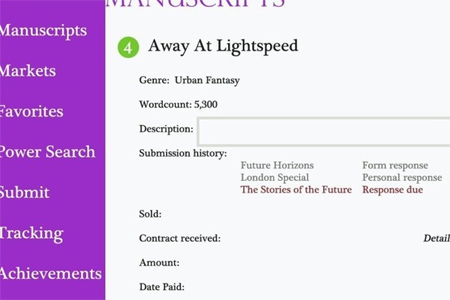
Writer Sylvia Spruck Wrigley, whom I’ve been fortunate to know for several years through the writing group Codex, has fired up an ambitious project to create a site offering a variety of important writing and publishing information, filling in the gap that’s left by Duotrope becoming an expensive, paid service and adding on a number of coveted writerly items. If you’re interested in checking the project out, hop over to Indiegogo and see where it stands: http://www.indiegogo.com/submitomancy .

No Comments

Is Your New Year’s Resolution Doomed by Uncertainty?

Habits

uncertaintyA resolution, whether it’s made at the New Year or any other time, is a fragile thing. It can get swamped by other priorities, be badly chosen and never bloom, die stunted from being planted with too many other resolutions, wither from inattention, or fail to thrive in any number of other ways. But even if we’ve chosen our goals wisely and pursue them relentlessly, there’s one necessity that can make or break us: certainty about exactly what we’re doing.
I’m running into this problem at the moment with eating habits. I’m training for a half marathon in the Spring, my first, and at the same time I want to eat lower on the food chain so as to fight climate change. I also want to manage my cholesterol better, since I have a genetic predisposition to cholesterol problems, but there are at least two major schools of thought on how to do that, and they’re completely opposed to each other. So do I want to eat better in the New Year? Absolutely: that’s a very important priority for me. Do I know exactly how I want to eat better? Well, uh …

It probably seems obvious that I need to understand exactly how I want to be eating before I can follow through, but the truth is that the traditional way of setting goals or resolutions skips this essential step entirely: we resolve to lose weight or to be more organized, to have more time with family or to increase our productivity-but the truth is, none of these are really resolutions or goals. They’re wishes, aspirations, the ways we’d like to see things turn out. They’re important to think about, of course, but in order to be successful we have to know what exactly we plan to do. Track calories every day for six months at MyFitnessPal.com and go to the gym at least three times a week come Hell or high water? Plan a family activity every weekend? Spend ten minutes every workday morning to organize tasks? Those are goals. Those are resolutions.

I’ll point a couple of things out about those examples: first, each one of them is quantifiable. You don’t have to guess whether or not you’re on track with goals like those. Second, they’re focused on what we do, not on what we want to have happen. We can largely control what we do; what happens then is a lot less under our direction.

If you’re working on a resolution for the coming year, good luck! You can find more articles on the subject at http://www.lucreid.com/?tag=new-years-resolutions.

Photo by norsez

No Comments

Four Days Left to Win a Kindle Fire HD

Luc's writing projects

If you haven’t yet entered the Kindle Books on Fire giveaway at www.kindlebooksonfire.com, you can get in just under the wire for a chance to win a Kindle Fire HD loaded with books. To enter, go to the contest Web page, choose the three books from the listing there that most appeal to you, then post the titles of your choices using Facebook, Twitter, our contest Web page, or all three. We’ll choose the winners on New Year’s Day. Full details are on the Kindle Books on Fire Web page, but the short version is that it’s easy to enter and free.

Our first prize winner will be chosen in a random drawing from all qualified entries and will receive a new Kindle Fire HD and all thirteen of the science fiction, fantasy, and historical fiction books from the contest page. Ten second prize winners will each receive the three eBooks they chose from the contest list when they entered.

No Comments

In Which Elizabeth Shack Continues Her Quest for a Simple Way to Track Habits

Guest posts

Here’s a handy guest post from fellow writing and fellow Codexian Elizabeth Shack, originally published here. If you’re interested in the topic, you might also like my posts ”Harnessing a Winning Streak” and “How Long Does It Take to Form a Habit?

The apps here are all iPhone ones. If anyone has suggestions for Android, PC, Mac, or Web-based solutions, please holler them out (via comments)!

About a year ago, I was looking for a habit-tracking app and never found a really good one. I wanted to make a list of 2-3 things I want to do every day, and check them off, without cluttering up my to do list or my calendar. For example: writing new words.

Maybe I was using the wrong keywords, or maybe tons of app developers secretly read my blog, because now there seem to be a lot of good apps. I’ve been playing with three of them.

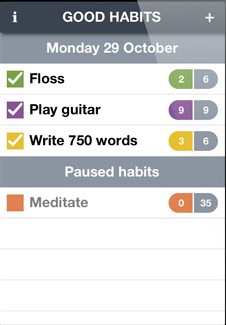
Good HabitsGood Habits (free) – This is the simplest and cleanest. It displays how many days in a row you’ve done each thing, and your maximum days in a row. Clicking on the name of a habit opens the calendar, where you can edit past days and see a monthly view of which days you did that habit. You can also set reminders.

That’s it. It’s almost exactly what I want, though it’d be nice to include things I only want to do once a week.

Habit ListHabit List ($1.99) – Not quite as pretty, but still nicely designed. It lets you set whether you want to do something every day, or on specific days of the week, or at a certain interval, or a certain number of days a week. That has the side effect of making me want to add more things to it, and it’s also a little confusing–my list for today includes everything that I’ve set to do only once or three times a week, so I see it on my list even if I don’t plan to do it today. (Setting something for a specific day like Friday makes it not show up unless it’s Friday, though.)

If you really need more specific habit scheduling than daily, this is a great app.

Habits ProHabits Pro ($2.99) – This adds more features and is the only app I’ve tried that has an export option. In addition to a daily checklist or monthly calendar view, it shows graphs by day, week, and month. You can also change the item type–instead of a simple yes/no checklist, you can have a counter (how many times you did something), a timer (how long), or a note (where you can enter details about whatever, like what book you read instead of just checking off that you read something).

It’s a little clunky to use and not nearly as pretty as either of the other two apps, but definitely more flexible in what you can track.

So after this research, what am I going to use? Well, I printed out some calendars that I can tape in my journal, where I can see the whole year on one page. If I want to stick with something electronic (and I haven’t quite decided), probably Habit List until Good Habits adds flexible scheduling.


Elizabeth grew up near Johnson Space Center and earned two physics degrees, so of course she writes more fantasy than science fiction. She now lives in central Illinois, where she performs cooking experiments, brings up the rear in 5k races, and does excessive amounts of yard work.

No Comments

Climate Change Posts: Eating Oil, Carbon Pie Chart, and Hope

Resources

Elsewhere on the Internet, I’ve been slowly learning something about climate change and working on ways to make a positive impact on that catastrophic, immediate problem. My blog at FaceClimateChange.com is about finding inspiration and motivation to make a positive impact on a daunting and horrific problem. Here are some recent posts for anyone who can spend a few minutes taking a closer look at what’s going wrong and what we can do about it.

I’ve also started a Twitter list of useful sources of climate change news and information at https://twitter.com/lucreid/lucreid-climate-change .

No Comments

New Year’s Resolutions for Change from the Inside Out

Strategies and goals

Jason Shen has an interesting blog I discovered only very recently. Entitled “The Art of A**-Kicking,” Shen’s blog focuses on “starting things, conquering fear and kicking a** in work and life.” In late 2010, Shen posted an article on New Year’s Resolutions that I highly recommend: “How to Set Great New Year’s Resolutions (Backed by Scientific Research!)

I’ve written about New Year’s Resolutions before (for instance, see “Should You Make a New Year’s Resolution?“, “Why New Year’s Is Such a Good Time to Make a Resolution“ and “Taking Stock for a New Year’s Resolution“), and you’ll find a lot of common ground between my posts and Shen’s. What struck me most about Shen’s article, though, is his emphasis on making resolutions about the way you feel. This fits with much of what I know about how people successfully change their behavior, and it struck me as an unusually useful way to come up with a resolution.

Most resolutions seem to be about achieving some external result: losing weight, quitting smoking … that kind of thing. The examples Shen gives, on the other hand, are about changing how we feel about some significant part of our lives. They raise the question “What can I do to feel happier?” or “What would make my lifestyle feel more healthy?” By focusing on how the resolution makes us feel, we get two special advantages: first, we’re focusing on the process instead of the outcome, which tends to be a more motivating approach for a variety of reasons. Second, we’re making a special point of ensuring that the actions we’re taking make us feel the way we want to feel, and that good feeling motivates us to keep pushing ahead.

Examples of result goals and feeling goals
An example: let’s say my resolution is to lose weight; it’s 3 weeks in; and I’ve lost 1.5 pounds after upping my exercise and eating a little better. That’s not bad, but it’s not very inspiring: it doesn’t really feel like I’m succeeding, just maybe sort of a little on the road to succeeding. I’m putting all my enthusiasm into the idea that some time in the future, I will have achieved something big. In the mean time, which could be a very long time, I don’t have much good news to announce.

If instead, though, my resolution is to feel more fit, then every time I complete an exercise session or choose the better food option, I’ve succeeded. It’s not a big success, but successes don’t have to be big to feel good, and anything that makes us feel good is much more motivating than something that makes us feel like a disappointment, or at best a potential someday-success.

Not affirming affirmations
As much as I like Shen’s post, I had some comments to add for my readers here on a couple of thing he mentions. One is his recommendation of affirmations, which from what I’ve seen of the research are often counter-productive. One problem is that they risk creating broken ideas, and even though an affirmation may create an upbeat falsehood (“I look great and am easy to get along with!”) it’s still a falsehood and has all of the drawbacks a falsehood usually has when we treat it in our own minds as truth.

What’s a “goal,” exactly?
I also find Shen’s distinction between “goals” and “resolutions” potentially confusing, depending on how you think about the words. He defines goals as “external targets that rely substantially on things outside of your immediate control” and talks about “resolutions” as being largely within your control. For what he calls “goals” I tend to use words like “aspirations,” and what he calls “resolutions” I and many other people interested in motivation often refer to as “goals,” for instance in the posts “One Good Way to Judge Goals: S.M.A.R.T.” and “What Kinds of Goals Really Work?” With that said, a lot of people use the word “goals” to mean exactly what he describes, too, and I think the way he talks about using the words makes plenty of sense; it’s different from how the word is used in here and some other places.

Both of us, however, are trying to point out an important distinction that the English-speaking world doesn’t usually make, that of whether we’re talking about something that we can affect ourselves (like finishing a project) instead of something that to a large extent is outside of our control (like getting a promotion).

One thing at a time
Finally, Shen recommends keeping your goals to no more than 2 or 3 at a time. I haven’t yet come across research to shed more light on the question, but my experience and my inference from some of the literature is that adding only one new goal at a time is generally the way to go. Once you’re well on your way with that one, adding another works much more comfortably. The danger of adding too many at once is that of not having enough attention to spare to focus regularly on any of the goals, so they all fail.

The exception to this would be very simple goals, like drinking more water or making the bed in the morning. It appears that we can tackle several small changes more or less at the same time and still see success.

Photo by pennstatelive

No Comments

We’re Giving Away a New Kindle Fire HD and 13 Engrossing eBooks

Luc's writing projects

I joined up with five other authors (Judson Roberts, Ruth Nestvold, Del Law, William Hertling, and Annie Bellet) to start a contest that runs all this month. First prize is a brand spankin’ new Kindle Fire HD with 13 eBook novels and collections of science fiction, fantasy, and historical fiction. There are also 10 second prizes of three eBooks from your choice of those 13.

You can enter the contest up to once each (so a total maximum of three entries) through Twitter, Facebook, and on our contest Web page by simply listing the three books that most interest you from the list. You can enter and get all the details here.

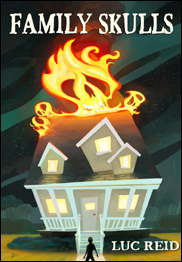
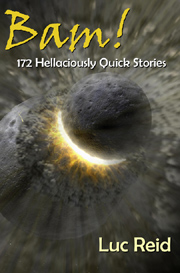
Contest books include my own Bam! 172 Hellaciously Quick Stories and my novel of Vermont backwoods magic, Family Skulls. Some of the other books are William Hertling’s two futuristic AI novels, Judson Roberts’ deeply researched and action-drive Viking trilogy, Del Law’s unique and engaging fantasy novel of humans and non-humans in overlapping worlds, Annie Bellet’s novel of crime in fantasy city called Pyrrh, and Ruth Nestvold’s Arthurian Romance-Adventure novels.

Winners will be announced on New Year’s Day, 2013. Enjoy, and good luck!

2 Comments

11 Essential Things to Know If You Want to Write Fiction for a Living

Writing

My 16-year-old son Ethan recently wrote his first short story intended for publication, and my niece, a high school senior, is visiting colleges like Middlebury, Williams, Wesleyan, and Bennington looking for a school that can help her develop a career as a writer. Just in case I wasn’t already thinking enough about the topic, I also recently received this question through my Web site:

Could you offer some advice for my 17-year-old daughter? She is about to apply to a Canadian college for English, and she aspires to become a novelist. Her strengths are writing, philosophy, drawing, photography. She wants to be her own boss, and not necessarily take courses that most people do if they want to become a writer-any advice?

In terms of my qualifications for answering this question, I should make sure you know I don’t make a full-time living at writing. At the same time I’ve won a major international writing award, sold a book and multiple short stories, gathered a large daily readership for my Web site, and appeared in magazines that are circulated around the world. What may be even more useful in answering this question is that I run an online writer’s group, Codex, and have had the opportunity to talk to literally hundreds of skillful writers, from people still trying to make their first pro sale to ones who make a comfortable living from their fiction, about their approach to building a writing career and their experiences trying to do that.

Based on that, here are the 11 most important things I can tell an aspiring fiction writer.

  1. Making a living writing fiction is a long shot, like making a living acting or painting. If you try to do it, try because you love writing and will write no matter what. If you don’t love it, spare yourself the heartache and aim for a field that can actually pay the rent. This article from a few years back explains some of the sad realities of trying to make a living in writing.
  2. As the article I just mentioned suggests, you don’t have to go to college to become a good writer, but for some people-especially people who haven’t had a college education in another field-it can be an important step. With that said, facing actual troubles in the real world and learning something from the process is usually the strongest basis for writing that connects with readers.
  3. Write only what fascinates you and draws your passionate interest. Don’t waste effort trying to write something solely because it seems more marketable, more respectable, more lucrative, more popular, or more seemly. Writing what you love will help inspire you, make it easier to push forward through difficulties, and will shine through in both your work and your promotion.
  4. You can make a living at novels, feature-length screenplays, and other long-form work, but consider writing many short works first to hone your craft, to boost your spirits with sales, and to gain some credentials.
  5. Never get angry at feedback or critique. Try to learn from it, and use it if it strikes a chord with you, but make a practice of understanding that your work is not the same as your identity and that nothing you can write will suit everyone. Also, learn to distinguish between “I don’t like it now, but I would if you made certain improvements” and “I don’t like it because I’m not the right audience for your work.”
  6. Becoming a better writer stems from practice and feedback. Write a lot and get people to read your work by joining critique groups, submitting to publications, blogging fiction, or any other means that gets you information about how people experience your work. A useful article on this topic is “Critique, Mentors, Practice, and a Million Words of Garbage.”
  7. Read a lot of books about writing, but watch out for advice that you have to do things a certain way. Many very successful writers seem to believe that their way of writing, editing, planning, outlining, or of structuring a career is the only one that works, and this is rarely true. They will promote their ways of doing things because those are the only means they’ve experienced. Talking to or reading about more writers will clarify that there is not just one way to succeed.
  8. The publishing world is in the midst of a huge upheaval, and the way to build a writing career has changed even in the last few years, closing some doors and opening others. Self-publishing and eBooks are now an essential part of the process, whereas they used to not matter. Pay attention to the changes in publishing, but don’t let them throw you. People will always be willing to pay for good stories, so there will always be writing careers of some kind, but don’t get too attached to your career unfolding-or continuing-in any particular way.
  9. The most important basis for a writing career is strong, professional, affecting, engaging writing. If you always strive to make your writing better, you will be investing in your career. However …
  10. Regardless of how good your writing is, you will almost certainly have to market it to someone, whether that’s an agent, an editor, a producer, the readers themselves, or some combination. Learn how to present yourself and your work professionally, how to summarize your writing projects effectively, and how to connect with new people who might just love your books.
  11. Guard your integrity: it’s extremely valuable and very difficult to regain if lost. Misusing online review venues, misrepresenting your publishing history, or mistreating your colleagues, for instance, will all ultimately tend to cost you more than you’ll get in short-term benefits.

Photo by Christopher S. Penn

2 Comments

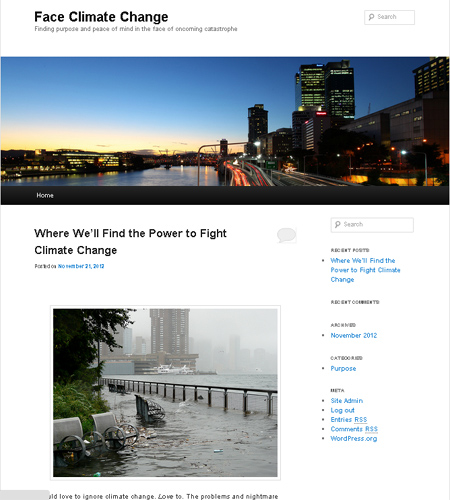
My new blog site: Face Climate Change

Resources

I’ve made it a practice in recent times to try to avoid taking on new projects. This is difficult for me, because I love coming up with new approaches to doing things, trying new strategies, and creating things, but at the same time it’s essential, because starting too many things means making it difficult to finish any of them.

Every once in a while, though, something comes along that is too important to ignore, and I need to step up and invest some real effort. Today that thing is climate change: it’s happening much more quickly than most of us imagined, and the results are more immediately devastating. For example, Vermont came very close to being hit by two tropical storms just a little more than a year apart. Vermont. This is a state where there are, generally speaking, no hurricanes, volcanoes, mudslides, earthquakes, tornadoes, tropical storms, or Lyme Disease-except that now we seem to be getting everything on that list except for volcanoes and full-blown hurricanes (though I don’t blame the occasional small earthquake on climate change, just so you know).

Looking at the problem, I see one particular way in addition to changing my own habits and environmental impact in which I might be able to be of some real help, and that’s in teaching principals that can help spread personal responsibility and courage and habit change skills, applied specifically to climate change. That’s what the new site is all about. I hope that if you have any interest in the topic at all, you’ll visit the site, comment, suggest resources, ask questions, or help move things forward in any way you’re willing.

My first post went up this morning: Where We’ll Find the Power to Fight Climate Change.

No Comments
« Older Posts


Switch to our mobile site